Where to Find Bernardsville's Gilded Age History This Winter
November 19, 2026
November 19, 2026
The stone station on Mine Brook Road was built in 1901 and 1902. Bradford Gilbert designed it in the Richardsonian Romanesque style, and the Historical Society of the Somerset Hills notes that it went on the National Register of Historic Places in 1984. Its original slate roof is part of the restoration now being designed, according to an October 2026 report on the Bernardsville council's station discussion. For now the waiting room inside is closed, and the building is something you see from the platform.
Most of what makes Bernardsville look the way it does comes from that rail line. Train service reached the town in 1872, according to New Jersey's National Register context study of the Somerset Hills country-place era. The trains brought New Yorkers looking for cooler country retreats they could reach from the city, and the estate-building era they started lasted until about 1940. The railroad shaped the downtown around the station and the Mountain Colony above it in the same decades. This winter those two halves are open to residents in very different ways. Downtown, the railroad-era buildings are mostly ones you look at from the sidewalk. On the Mountain, you can walk the grounds of two former estates on any day of the week.
The colony started before the trains. Bishop Edmund Janes kept a retreat on the mountain and was selling land there before the rails were laid, and those sales drew a small group of promoters. The state's context study names banker George I. Seney, banker Andrew V. Stout and architect George B. Post. Seney bought 382 acres in 1871, the year before service began, and Stout's estate was called Crowndale.
The early estate names read like a guest list. Post built Crow's Foot in 1886, and it was later renamed Stronghold. Robert Seney's house, Yademos, dates to 1881. Samuel Borrowe had The Hut, Jane Boudinot made a farmhouse into an estate, and Frederic Olcott had Round Top Farm. The Stevens, Astor, Pyne, Kunhardt and Schley families followed in the 1890s and early 1900s, when the estates grew larger. George Seney's holdings reached 1,072 acres. The Somerset Land Company inherited them and ran the Somerset Inn as a resort, a name the property carried from around 1887. Crow's Foot and Yademos are the only two country houses from before 1890 known to have survived into the later record.
The money from the Mountain also built things downtown, which is why a walk through the colony's history can start at Olcott Square.
The station building is the clearest example. NJ Transit lists the waiting room as closed until further notice for construction and rehabilitation. The platforms and parking lot are open as usual. Asbestos stabilization is complete and design is about 60 percent finished, according to the October 2026 report. At the October 26 council meeting, Mayor Mary Jane Canos read NJ Transit's target schedule aloud. It calls for full design by the third quarter of 2027, bids in the first quarter of 2028, construction starting in the second quarter of 2028 and completion in the fourth quarter of 2029, according to Citizen Portal's account of the meeting. The waiting room will stay closed until the work is done. Until then, the best view of the stonework is from the platform or from across Mine Brook Road near Station Tavern.
The Bernards Inn at 27 Mine Brook Road is the downtown landmark you can walk into. It dates to 1907 and still operates as an inn and restaurant. The Bernards Inn's own history page covers the building's past, and a reservation in the dining room is the simplest way to spend an evening inside one of the town's early-1900s buildings.
St. Bernard's Church opened in 1898 and was extended in 1904 and 1905. In an account first published in November 2025 and updated this month, the Historical Society of the Somerset Hills notes that the church's original parish house was converted into condominiums at The Heritage at Claremont. Some residents of that complex live in a building that has served the parish since the colony years.
The Olcott name appears all over this part of town for a reason. Frederick P. Olcott, the Round Top Farm estate owner, gave the Olcott School to the community in 1905. Classes moved out in 1985, and the building became administrative offices, according to the Historical Society's history of the Olcott Avenue district.
One downtown building is about a century older than the railroad. Preservation New Jersey describes the Boylan House at 35 Olcott Square as the second-oldest building in downtown Bernardsville and links it to Dr. James Boylan, a Revolutionary-era physician and landowner. The organization put it on its 2025 list of the 10 Most Endangered Historic Places on May 6, 2025. The house dates to the 1770s. From 1865 to 1902, the decades when the Mountain Colony was taking shape, it was a Methodist parsonage, and the Palmer family acquired it in the 1950s, according to the Bernardsville News.
The house sits inside the redevelopment site at Route 202 and Mount Airy Road. The approved plan from AR at Bernardsville, LLC, which Advance Realty Developers of Bedminster controls, keeps the Palmer Building on the corner. It removes two other commercial buildings, including the Boylan House, and adds 67 apartments with ground-floor retail and a two-level underground garage with 134 spaces. The Planning Board approved the settlement site plan 8 to 0 on July 24, 2025, the Bernardsville News reported. For anyone who wants to see the 1770s facade, Olcott Square is the place to go.
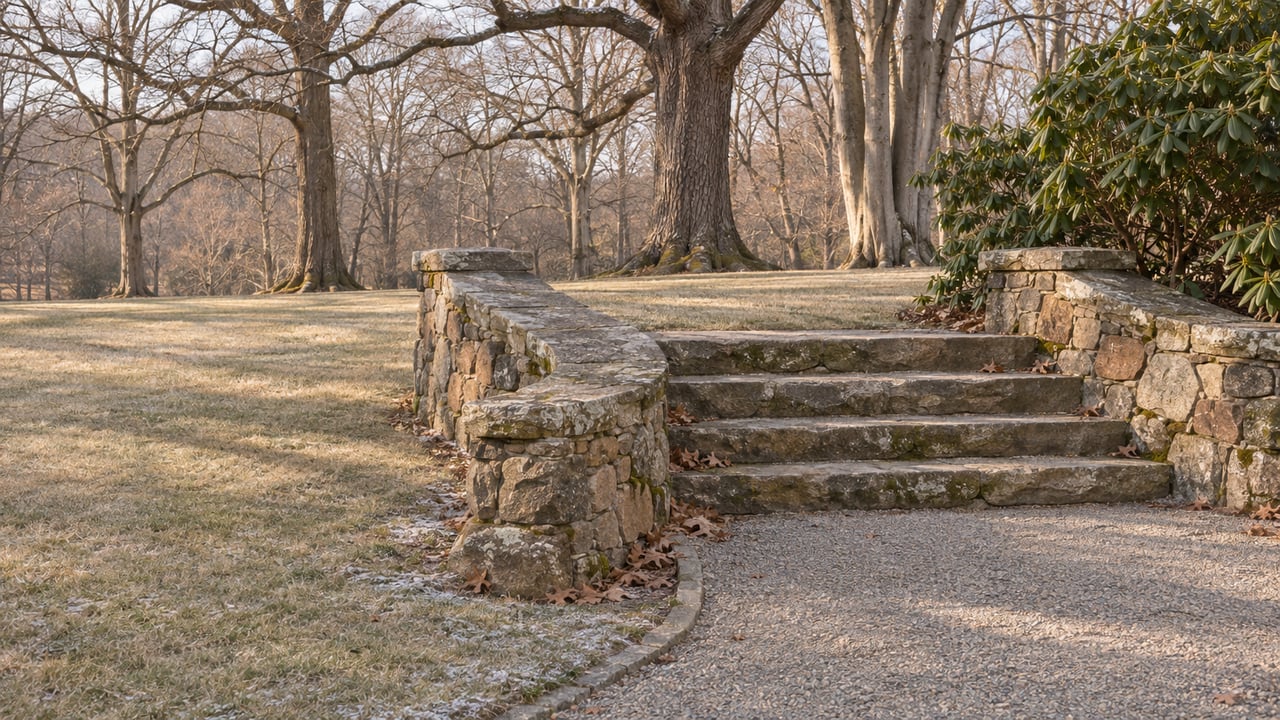
The former estates are where you can still walk through the colony's history, and the best example is on the town's northern edge. Cross Estate Gardens, at 61 Jockey Hollow Road, belongs to Morristown National Historical Park. John and Ella Bensel built the house in 1905, William and Julia Cross bought it in 1929, and the National Park Service bought the property in 1975. According to the National Park Service's page on the Cross Estate, the house and outbuildings are closed to the public. The gardens are open, and a hiking trail runs from them toward the New Jersey Brigade encampment, so a single walk takes in both a Gilded Age garden and Revolutionary War ground. The park's hours page, updated November 2, 2026, lists the grounds as open year-round from sunrise to 5 p.m. That page also posts any alerts, so it's worth checking before a winter visit. Parking and admission are free.
Volunteers from the New Jersey Historical Garden Foundation keep up the gardens, working Wednesday mornings from April through November. Their Spring 2026 newsletter reported that a silver maple had fallen onto the pergola and that pillar repairs were planned under National Park Service oversight. The volunteer season ends as the month does, so a December visit shows the garden's structure without its plantings.
The second estate is closer to downtown. Scherman Hoffman Wildlife Sanctuary, at 11 Hardscrabble Road, began in 1965 when Harry and Bernadette Scherman donated 125 acres. G. Frederick Hoffman later donated more land, and his estate house and caretaker's house joined the sanctuary in 1981. New Jersey Audubon now runs the Hoffman house as the Hoffman Center for Conservation and Environmental Education. Many Bernardsville residents know the sanctuary from its trails, which we covered with the borough's own trail network in an August post. The building's hours make it one of the few colony-era interiors you can enter on a weekday. New Jersey Audubon lists them as Wednesday from 10 a.m. to 3 p.m., Thursday through Saturday from 9 a.m. to 5 p.m. and Sunday from noon to 5 p.m. It is closed on holidays, which includes Thanksgiving Day. The trails are open dawn to dusk every day.
The order these places were built gives you a route. Start on the station platform, where the 1872 rail line arrived. Walk up to Olcott Square to see the Boylan House, which was already about a century old when the first trains came. Pass the Olcott School, St. Bernard's Church and the Bernards Inn, which estate money and estate-era demand helped build between 1898 and 1907. Then drive up Hardscrabble Road to the Hoffman house, and on to Jockey Hollow Road for the Cross gardens before the 5 p.m. closing. Any day from Wednesday through Sunday has both estates open, and from Thursday through Saturday the Hoffman Center opens at 9 a.m.
This history is also a big part of why homes in the borough look the way they do. If you own one of Bernardsville's older homes and want to know how its age, its street and its connection to the colony years figure into its value today, Karen Tyrell would be glad to talk it through with you, starting with a free home valuation.
Stay up to date on the latest real estate trends.
Get assistance in determining current property value, crafting a competitive offer, writing and negotiating a contract, and much more. Contact me today.